Tuesday, 29 October 2013

Cinematography - Shot types/Camera movements.


Camera shot
There are many different Shot types and Camera movements involved in films. These make them more interesting and they build up tension, excitement and curiosity.

An extreme long shot contains an excessive amount of landscape. It is often used at the beginning of a movie or scene to indicate the setting; the general location.


A long shot contains landscape but it gives the viewer a more detailed view and focus on the setting.

    A medium shot is a camera angle where the subject is in the middle distance, allowing some background to be seen.


A close up camera angle shows the subject close to the camera where you can see great detail but very little background. 
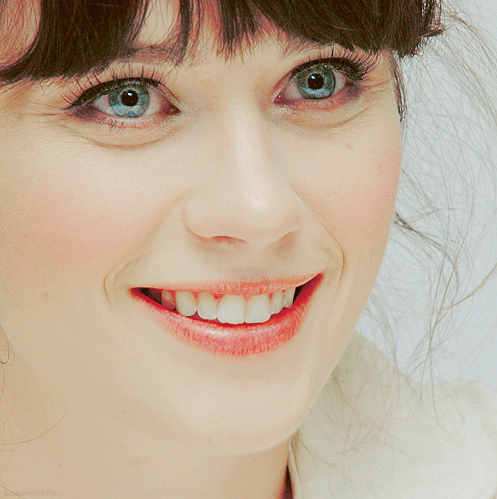
                          

An extreme close up camera angle contains no background; it focuses on one certain aspect of the subject, maybe the eye or the mouth of a person.


A point of view camera angle shows the viewer the image through the subjects eye.


A low angle camera shot looks up at the subject, making them seem inferior, powerful and big.

                     
A high angle camera shot looks down on the subject, making them seem small, inadequate and weak.


Camera movement

Camera movement is the motion of the camera during exposure. There are many different types of camera movements used in film and photography to make it more appealing to the audience; it creates different types of emotion and it makes the film vary from others.

Pan is a camera movement that follows the subject to create a panoramic effect. It could show the direction in which the subject is heading or it could even be used to show the setting of a scene.


Tilt is a camera movement in which the base remains stationary but the head of the camera moves up and down. it can be used to show the size of a building or to reveal a character.


A tracking shot is a camera movement where the camera follows the action on rails or tracks. It is often used to follow action; e.g. subject running away.


A crane shot is when the camera lifts upwards whilst still focused on the subject, often for high angle shots. This type of movement can be used to reveal secrets or significant events.


A steadicam has the freedom of a handheld shot but because it is so stable, it smooths out the bumpiness that would result from a handheld shot. It can be used to show point of view but also to suggest dreams and fantasies.


A rolling shot is when the camera is still focused on the subject, but the camera rolls to the side slowly to give a thrilling or shocking effect.


Wednesday, 23 October 2013

North By North West Evaluation

North by North West was an Alfred Hitchcock film in 1959. Hitchcock was famous for thrillers such as Psycho and The Birds, and so this film would have created an audience of fans just because it was one of his films.

The trailer for North By North West would have appealed to the audience for many reasons. One main reason was because it was in color; not a lot of films were in color in those days, they were mainly black and white so it would have made it very special. Also there were many special effects involved in this film with quite good quality, so that made it very interesting for in those days, to create scenes in movies that are similar to North By North West would be thought to be dangerous.


The Blurb
An innocent new yorker advertising executive is mistaken for a government agent by a group of foreign spies who want to stop his interference in their plans to smuggle a microchip out of the country. They follow him all across the country whilst he looks for a way to stay alive.


This is an archetypal thriller for it is fast pacing, tension building and exciting. There are some scenes which make you wonder just how the main character, Roger Thornhill, is going to escape, such as the auction scene [spoiler] where he had to start a fight to prevent the villains from getting to him. 
 
"Thrillers are characterized by fast pacing, frequent action." This is shown in the scene where the villains get Thornhill drunk and put him in a car which they almost succeed in driving him of of a cliff, but then it turns into a chase. Also, there is a famous scene where Thornhill is getting chased by a crop duster and we have no idea how he will escape from it.This is also an ionic scene for it had good quality special effects, which isn't very common in movies in those days. Also, it was a great thriller scene and it got the audience's heart's racing and the tension and suspense was building on whether Thornhill was going to escape alive or not.
 "Resourceful heroes who must thwart the plans of more powerful and better equipped villains," is shown in North by North West for the hero, Thornhill, is just an average guy. He was mistaken for a government agent and so he had no power over anything that happened.

There was a Red Herring in this movie for we all thought that the woman, Eve, was a villain, for she was working with the bad guys and she set Thornhill up. However, we later on find out that she is actually a government spy and she was working against the villains all along. That is the red herring.
There is also a cliffhanger halfway through the movie where Eve shoots Thornhill and the movie just stops. But then we see him getting out of a car later on once the detective has taken him away from the scene, presumably dead.
 
"A thriller is a villain driven plot, whereby he presents obstacles the hero must overcome." This is shown in the film by the use of a MacGuffin, which is where the villain has an immense interest in something that the audience doesn't care about. In North By North West, the MacGuffin is the Microchip, and the villains would sacrifice anything to get that microchip and smuggle it out of the country.

Hitchcock said thrillers allow the audience "to put their toe in the cold water of fear to see what it's like." The audience are looking at a nightmare. Thornhill was just an ordinary man who was mistaken for someone he was not, and suddenly his life changed; he was suddenly a murderer, a convict, a criminal. Nobody wants that to happen, and so that is a nightmare. Hitchcock explains that if he were to make this film as a proper nightmare would be, then it would not be a narrative, it would not be smooth. But he made this movie into a nightmare being made of a real life situation and so that is why Hitchcock has succeeded in this film.

Sound Evaluation

The story of my sound exercise was an interview of a movie star. Ellese was the interviewer and Ruby was the movie star.
It starts off with a board with the words "The Evening Talk Show" and on the side was "Halloween Edition," with a pumpkin next to it. Then we shoot to the interview where they speak about an upcoming horror movie, and relationship rumours about the two stars, Esme Waters and Frederick Grace.


We included diagetic and non-diagetic sound through the use of soundtrack and conversation. We had music for the opening of the show, which would seem as though this music was always played at the start of these shows. Also, when Ellese mentioned that this show was the "Halloween Edition," we added an evil laugh for a Halloween effect.


When we first filmed, we had planned on having an interview and then an advert. However, once we finished filming, I went to edit and found that we had lost our forage for the accident, for as had filmed over it by accident.
I edited the interview and it took about two lessons to edit and find all of the sound effects and music.
However, we did not have enough time to film the advert again, so we just had to make do with the interview footage on its own.
Another downside to our film was that a small part of our conversation was overlapped by the music and we couldn't edit the part of the conversation back.


However, I think that our interview footage went smoothly, which is one of the positive elements of our film.
Also, we had continuity, for we wore the same clothes throughout the footage, and our music fit in well with our storyline.

Sound exercise


Thursday, 17 October 2013

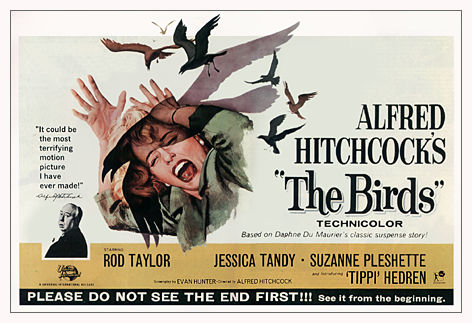
The Birds by Alfred Hitchcock analysis.


"The Birds" was a film made in 1963 by Alfred Hitchcock. It stars Rod Taylor, Tippi Hedren and Suzanne Pleshette. It is a thriller movie, however it can also be perceived as a horror.
The trailer for this movie contained certain aspects that are associated with a typical thriller. It is very tension building, quite a bit of action, especially when she is in the telephone booth and the car blows up. Also, there is a tracking shot when the children are running away from the birds and there is a massive chase scene which is normally associated in a thriller.
This appeals to the audience for it stars famous actors/actresses in those days. Also, many special effects were used in the filming of "The Birds." Most movies in those days did not contain quality special effects, and so the fact that this thriller contained many special effects can have made the film appeal to the audience. Back in those days, there wasn't much color in television and film productions, so with "The Birds" being in color, it also made it special, and made people want to see it for it wasn't the usual black and white that the audience was used to.
"The Birds" is an archetypal thriller for it is like an apocalypse of birds. It is thrilling, and fast-pacing action. Also, the line "This time, the external threat is from nature!" makes it more thrilling because it is unusual. Also, the movie involves some dramatic irony, for in the school scene Tippi Hedren does not know acknowledge the birds that have been gathering but the audience does, and so we know something that the character does not.
                                
 "Thrillers are characterized by fast pacing, frequent action."
One example of this is the scene where the birds are attacking the children.

The children are running and trying to get away, and the birds are swooping down at them and attacking them, and so this is fast pacing and frequent action. The children are screaming and the birds are screeching so this builds up the tension more for you wonder what is going to happen; is a child going to get hurt? Is one of them going to fall over and be pecked to death like the last few murders that the birds have caused? What is going to happen? And so this is a very good example to prove that the sentence  "Thrillers are characterized by fast pacing, frequent action," is correct in 'The Birds.'

The sentence "Resourceful heroes who must thwart the plans of more powerful and better equipped villains" works in some cases of 'The Birds.' The heroes in this film are Tippi Hedren and Rod Taylor, but they seem near enough useless towards the birds. They are good at getting rid of the birds though, and they always seem to escape, so maybe that counts for thwarting the villains plans. However, humans have some power over the birds, for they can shoot them down with guns. But there are unlimited amounts of birds in the world and so that plan could not work, and so the birds would win for they have sharp claws and beaks. So the sentence is correct.
The MacGuffin of 'The Birds' is when Tippi brought Rod Taylor the two love birds; it was important to het but the audience didn't care, for they thought there was going to be romance. But once the birds started attacking, the two lovebirds that were given as a gift were completely forgotten about, and so that was the MacGuffin.

There was many different endings that the director wanted for this film. One was to have the Golden Gate Bridge entirely covered by birds, but Hitchcock ended up having the film finish without the usual words 'The End,' for he wanted to give the impression of unending terror.

Here are some of Hitchcock's thoughts for the film.


Hitchcock wanted people to understand and realize that mankind has abused birds throughout history. He used a bird-loving old lady as a character to show that nobody agrees with her and everyone feels that birds are unnecessary for just after she spoke, another character ordered southern fried chicken at the bar.
Hitchcock also said that our usual evasions, which are science and religion, denies us. We are on our own.

Hitchcock said that thrillers allow the audience to "Put their toe in the cold water of fear to see what it's like." I feel like he has succeeded in this film for he wanted to put the message out there that we shouldn't abuse birds just because we can, that we need to stop being ignorant and thinking that we are all the alpha males because we are human; that we think we are more powerful than every other living being. He was trying to show us that we are not the most powerful in the world, we are weak compared to the birds, and most other species, so we should treat them with respect, or it could come back to bite you.

Monday, 7 October 2013

AS Thriller Camera Shots


In our Media studies class, we composed a film showing our understanding of different camera shots.  Our storyline was about two women meeting in a room to converse about an unknown object. The women were unidentified, and so everything about our film was a mystery, and why the woman at the end was so distraught by not obtaining the unknown object.
We included almost all of the camera shots. However the only shot we did not include was the Crane Shot, for we did not have the required equipment, and it would not have linked to our storyline in any aspect. Each shot had a particular meaning; they were all used to create tension and excitement, such as a point of view used first, and then tilt, showing whom the mystery character behind the point of view was. Also, we used Over The Shoulder shot for the conversations involved in our short film. This showed the other character’s expression and reaction to the speaker. It is a popular way of presenting conversations in films, for it involves both of the characters in some form. It also made the talking character seem important and powerful, for she was standing whilst the character she was talking to was sitting.

The Point of View shot first created wonder, for you don’t know who’s point of view it is, you don’t know anything about this character. Then the tilt created curiosity, for the audience was finally going to find out whose Point of View was shown, and what the character looks like.  We used a close up into an extreme close up to show the serious look on the characters face, trying to show how serious she was to get the object. For the Low angle shot, it showed powerfulness, for it showed how the first character shown is powerful, for they are looking down to the camera. 

We used Pan to establish the surroundings of our setting.  We has a Tracking Shot of the woman walking into the room, to show the pace of her walking, with which we also used a Medium Shot to show how serious the character was when she walked into the room.  We used Rolling Shot to show the desperation in the characters face, and how shocked she was when the other character said she didn't have the unknown object.
 The last shot we use is a high angle shot which we use to show how vulnerable and weak the character was when she didn't obtain the unknown object.

There was a scene in the movie that was used to show the character’s desperation, which was the ending, where the character bangs on the table shouting “No!” in frustration. That movement was to show how desperate that character was to obtain the unknown object.
I think that our choices were very successful; it created tension and mystery, making the audience wonder what this unidentified object was and why it was such an important aspect to these two characters.
Also, i think that our shots were very successful, for I noticed there was hardly any shaking whilst we filmed.
From our short film, I understood that most of all, you need plenty of footage, just in case any gets lost. I need to make sure that next time, my short film is a bit longer, for it was only 49 seconds, whereas the maximum was 2 minutes, so we need to make it longer, therefore we can fit in a bit more information, maybe on the unknown object, or the actual characters.
Also, the lighting is very important; if there is too much sun then it would be hard to figure out the characters; you wouldn't be able to see the detail in their facial expressions or maybe even see their posture. However, it would also be the same if it was too dark, and so lighting is very important in filming.